Sept. 17, 2025
By KENNETH J. BRADDICK
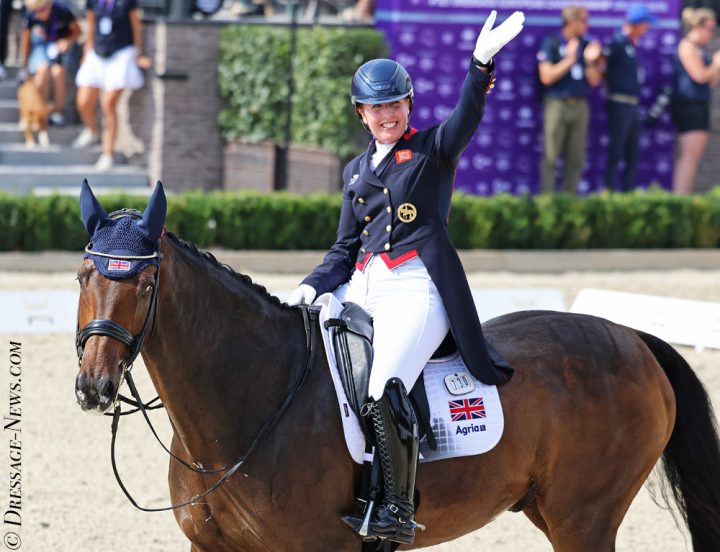
Since a last-minute draft to Britain’s Olympic team a year ago with no senior championships on her record, Becky Moody on her home-bred Jagerbomb now has Olympic bronze and European silver medals and climbed to No. 4 dressage rider in the world.
With a broad smile most of the time displaying her joy competing at the top of the sport, Becky has put behind her the difficulty as a rider moving to what she jokingly describes as the “big bad world” of senior level after success at four youth European Championships at the turn of the century.
And Jagerbomb, the gelding that is now 11 and has been her partner since she bred him, Becky didn’t have much hope as a young horse “always beautiful in his frame, always beautiful in his temperament, but a little bit lazy, and a little bit straight-legged.”
Even so, she persisted, and the past year turned out remarkable for “firsts”–beginning with the call up at the last minute for her first Olympics, the first time competing at the globe’s premier World Equestrian Festival at Aachen, Germany and the first senior Europeans, in Crozet, France.
Becky grew up in a horse family. Her mother had been a pleasure rider and her two older sisters were into horses so Becky was riding before she could walk. At four, she got her first pony, a strawberry roan called Kelly that was also aged four.
“We kind of grew up together and super, super keen pony clubbers, all of us,” she recalls. “We did all Pony Club things from geeky quiz teams to area horse trials and show jumping and dressage. I think I was probably only about 10 or 11 when I started to get more interested in the dressage side of it.”
Although initially she was most interested in eventing, she said, over time “I realized I quite simply was not brave enough to go eventing–brave enough slash crazy enough. Right, there you go. I think it would be fair to say we’re quite an artistic family and I quite like the artistic side of dressage, it really appeals to me as well.”
Becky was successful in representing her nation in four youth Europeans at the turn of the century and an appearance at the World Young Horse Championships in 2012. Her entry into international senior level competition coincided with success in the top ranks of the discipline in Britain, a team that won the country’s first Olympic dressage team gold medal, at home in London in 2012.
She left school at age 16 to help with horse stables being set up at home, although the path was different than other family members–her father was an Oxford graduate, both her sisters went to university–they were “enormously supportive.” The facility has grown to 30 stalls with Becky and her sister, Hannah, training horses and coaching people of all different levels.
But competing is what really drives Becky.
Her development in the sport before the Under-25 division “was such a tough step from young riders straight into the big bad world of seniors and Grand Prix is such a million miles away from small tour. So I found that transition really quite difficult. I think I had a horse that was super talented, a young rider horse, he won bronze medal, team medals and he won our national championships at Prix St. Georges and Inter. 1.” She had trained to be a really good young rider but not at senior level.
Becky bought at auction a green seven-year-old mare out of the Dutch Jazz, but the horse incurred a serious injury when developed enough to start Grand Prix that ended its competition career. Other efforts included Carinsio, a KWPN gelding that she competed at the 2012 World Young Horse Championships and developed to Grand Prix ride on Britain’s Nations Cup team in 2017.

Although she favored breeding one of her mares to stallion Danone, the Hanoverian wasn’t available so she opted for Dante Weltino OLD, the black Oldenburg stallion that was seven years old at the time and had been sired by Danone. Sweden’s Therese Nilshagen competed Dante Weltino at both the Tokyo and Paris Olympics, 2018 World Equestrian Games in Tryon, 2022 World Championships and four consecutive Europeans.
“I don’t hold back from the thing that I did not think that Bomb was that good a horse as a young horse,” she says. “So, always beautiful in his frame, always beautiful in his temperament, but a little bit lazy, and a little bit straight-legged. He didn’t articulate his joints very well and I just thought he was a lovely horse but not in a million years as a four and five year old did I think he was this kind of a horse. I mean just not even vaguely. And I think probably he did start, you know, when he was maybe six, coming seven, we started playing a little bit with the half steps and he was very natural for it.
“And he was just the kind of person that every question you asked him, apart from the sharpness, every question you asked him, he was like, ‘yeah, okay, I’ll give it a go’. The energy levels were a little bit more tricky. That’s taken longer and it’s taken atmospheres like this. So I think you know as a seven-year-old young horse was the first young horse class I did with him because prior to that he was just not a young horse class kind of horse. He wasn’t scopy and loose and big moving. But then by the time you get to seven obviously it’s a little bit more about the training and the development, and he actually won our national seven-year old-championship and just piaffed all the way through the prize giving. At which point I kind of thought, ‘okay, maybe he’s a little better than I thought.’ But I think, if I’m really honest, I still thought I’ve just got a nice Grand Prix horse. And I think even when I was really lucky and was able to go to Riesenbeck (Germany) Europeans (in 2023) as a traveling reserve I think even then I still was kind of like, ‘hey, you know, he’s nice but he’s not, he doesn’t compare enough to the other horses’.
“But then at London that year, that was the first year we did London International. And he was just fantastic. He was amazing because the crowd, the atmosphere gave me what I needed. So suddenly I had the hotness. You know, he was already so much better in his movement. He articulated his joints more. He had a lot more cadence, but it was the atmosphere that gave him that even more kind of ba-ba-boom. To me that was the point where i was like.’ okay he’s a really super talented person. Was that a shock to you? I think it was the realization that he really was not just a good horse, he was a super horse. He was the real deal.”
Part 2: Jagerbomb “having the time of his life” at top sport