New “Blood Rule” for Show Jumping Labeled “Very Disappointing” by Austrian Federation President Max-Theurer
2 months ago StraightArrow Comments Off on New “Blood Rule” for Show Jumping Labeled “Very Disappointing” by Austrian Federation President Max-Theurer
Nov. 10, 2025
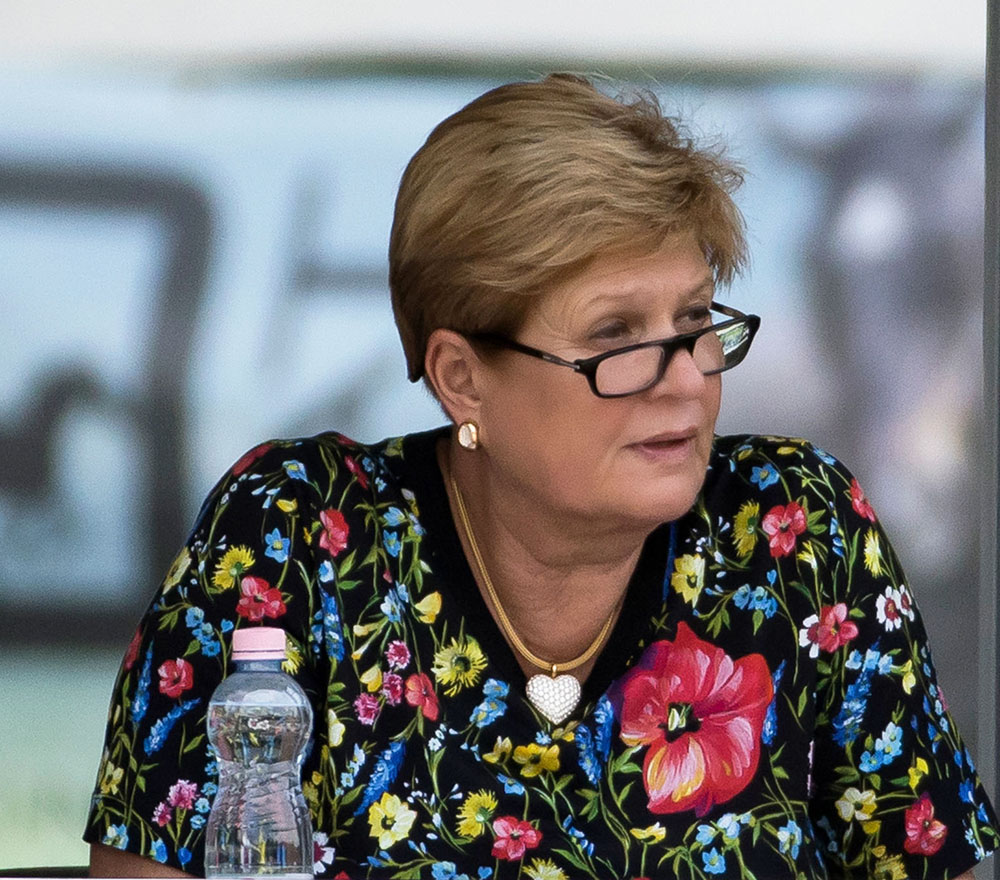
The new “blood rule” for show jumping approved by the International Equestrian Federation was labeled “very disappointing” by Austrian federation president Elisabeth Max-Theurer who is also a top level dressage judge.
The controversial rule was passed 56 in favor to 20 against at the FEI annual General Assembly last week. It was supported by the United States and opposed by Germany, Switzerland, Denmark, Sweden, Netherlands and Austria.
“In the future, riders will be allowed to continue competing even with minor bleeding,” said Elisabeth. “I consider this a clear step backward. This change is neither in the best interests of the horse nor of the sport.
“Blood, especially around the mouth or flanks, should never be considered acceptable in equestrian sport. If a horse bleeds due to the rider’s actions, it’s a sign that something is wrong. Then the horse’s protection must take precedence–not the continuation of the competition.”
Austria, she said, will maintain the current policy that blood on the mouth or flanks leads to immediate disqualification as the horse’s welfare is paramount.
“I consider it our duty to set an example here,” said the winner of gold at the 1980 Moscow Olympics. “Equestrian sport must not stray from its ethical foundation. We must demonstrate that sporting success and animal welfare are not mutually exclusive. Only in this way can we remain credible–to the public, to sponsors and, above all, to the horses themselves.”
The FEI’s argument that the new rule brings “more transparency and objectivity” and improves animal welfare, she described as “pure window dressing.”
“Why is a horse even allowed to compete with blood on its body?” she asked.
“It sends a bad message. Equestrian sport is constantly in the public eye. If the impression now arises that blood is tolerated ‘to a certain extent,’ it massively jeopardizes trust in our sport.”
Elisabeth criticized the voting structure pointing out that all nations get an equal vote–France with 11,204 registered competition horses and 5,391 registered athletes, or, for example, Angola or Ethiopia with zero registered horses and athletes—has exactly one vote.
“That’s absurd,” she said. “Countries with no significant equestrian activity are deciding on regulations that affect the very core of our sport.
“I’m not questioning the voting itself, but the structure behind it. This has nothing to do with true democracy. We urgently need a reform of the voting system.”
European equestrian nations bear the responsibility and finance large parts of the system: the entire European federation has 59,096 registered horses and 28,136 athletes, but only 42 votes. All other groups worldwide have a total of 18,541 registered horses and 13,785 athletes but 92 votes.
“As long as this imbalance persists,” she said, “one cannot speak of ‘democratic decisions’ in the true sense. This seriously jeopardizes the credibility of the FEI.
“Furthermore, animal welfare is thankfully a very important factor in Europe. In many voting countries, human rights are not highly valued and animal welfare is likely even less so.”
The decision means that in the long term “it jeopardizes the acceptance of our sport and thus also its Olympic future. If the world governing body makes decisions that weaken animal welfare, it provides ammunition to all those who already want to remove equestrian sport from the Olympic program.
“We must be aware: equestrian sport can only survive if society sees the horse as our partner, not a means to an end. Every rule that dilutes this principle is dangerous.
“I’ll say it openly: If the FEI continues like this, we will eventually lose Olympic status for show jumping, dressage, and eventing and for para-dressage at the Paralympics.
“The pressure on the IOC (International Olympic Committee) to critically examine sports involving animals is growing. Therefore, any weakening of animal welfare is a step in the wrong direction.”
“We demand a uniform, cross-disciplinary regulation that applies to all FEI disciplines and fundamentally prohibits blood on the mouth and flanks. Furthermore, a fairer weighting of votes must be seriously discussed. Only then can professional expertise regain its significance.”
Technological developments announced last week “must not obscure the fact that the foundation is crumbling,” she said. “Without clear ethical guidelines, even the best systems are useless to us.
“The horse is a partner, not a piece of sports equipment. If we forget that, we lose more than just our place at the Olympics we lose the very essence of our sport.”
