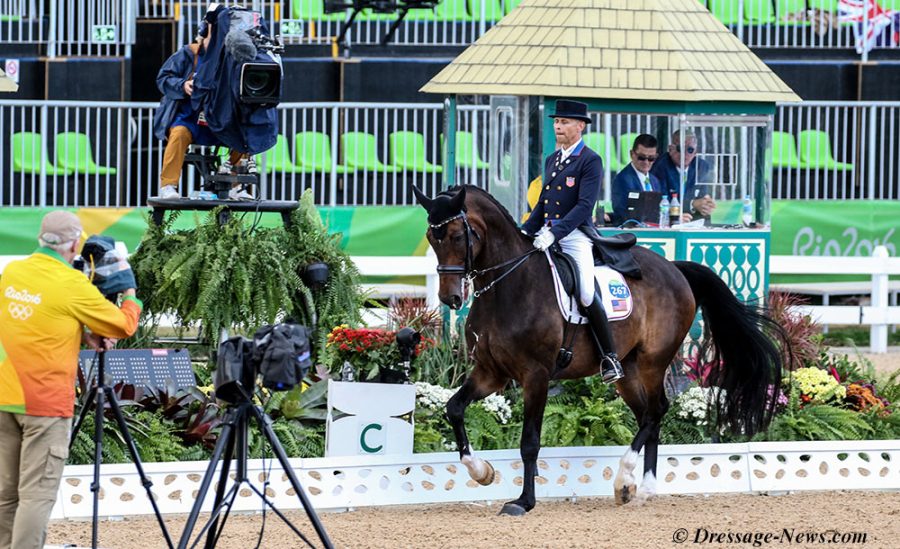
Steffen Peters With 6 Olympics at 61 Back to Enjoying Life–And Riding
3 days ago StraightArrow Comments Off on Steffen Peters With 6 Olympics at 61 Back to Enjoying Life–And Riding

Jan. 6, 2026
By KENNETH J. BRADDICK
Steffen Peters has six Olympics on his record at the age of 61 but feels and acts like a teenager as he develops two horses for the first time in years after struggles with physical and mental health issues.
The owners of both horses, who don’t want them identified publicly, want Steffen to show them which would be the first competitions for Steffen since the Olympics in Paris in summer 2024 followed by a year away from riding while dealing with a nerve affliction.
And he’s feeling no pressure to get back into the show ring as the United States has the luxury as the host of the 2028 Olympics in Los Angeles of an automatic team slot (as long as the rider and horse combinations meet the easily attainable minimum score requirements). That means the USA is not subject to the results of qualifying competitions such as the World Championships in Aachen, Germany in August or the Pan American Games in 2027. LA28 is at Santa Anita racetrack is just 120 miles/194km from his farm in San Diego.
“I have two wonderful horses in training,” he told DRESSAGE-NEWS.com. “They’re not sponsored horses. They’re horses in training. And both owners would like to see that the horses are being shown; one probably at the Small Tour and the other horse at a Grand Prix level. And I would say, the small tour horse probably CDI, but then the Grand Prix horse first national.
“That’s something I haven’t done for quite some time. But you know, it’s just, different now. You know, I don’t even have a certain show in mind. I know next year it’s most likely to happen at one point, but it’s just nice to have that luxury to say, listen, we just simply allow the horse to tell us when they’re ready.
“There’s not a team spot we’re chasing or have to chase. There’s simply no pressure from anyone, and especially not from myself. That honestly makes it a whole lot more fun. And also, I mean, the U.S. has the luxury this year or this Olympic cycle of not having to do anything. Of course, you know, after doing six Olympic games, that’s always in the back of your mind. You know, could you do another one? But honestly, I have such a blast riding at the moment more than ever.”
The Grand Prix horse is what he describes as “a little bit on the hot side, in fact, it’s hotter than Mopsie (Suppenkasper).
“And just knowing what do to settle those horses down and still getting the movements done, getting weekly improvement in quality as far as the gaits, relaxation. movements, you know, and honestly, I’m having a blast.”
“I don’t rush it in the morning. You know, I do my routines, my gym workout or my swim in the morning. And then sometimes I start as late as 9, 9:30. That’s a luxury that I never had for 14 years.
“So, you know, it’s fun. And I think the horse feels it, that there’s no pressure, you know, and the horse is clearly allowed to tell me when it’s ready to show.
“You don’t have a… team spot breathing down your neck. You don’t have a next show breathing down your neck. You know, I look at the, even at the property, I look at it differently and just, just enjoy it. Right. You know, truly, truly enjoying it.”
“That’s right. You know, it’s almost very human.”
His schedule enables Steffen to come to Wellington to host clinics arranged for many years by Ilse Schwarz, an Australian based in Florida who became an American citizen.
Steffen, born and brought up in Germany, became an American after moving to California. His first Olympics was on his Udon in Atlanta in 1996, followed by Ravel at the Beijing Games in 2008 and London in 2012, on Legolas at Rio de Janeiro in 2018 and on Suppenkasper in Tokyo and Paris. The US teams earned a silver and two bronze medals at those Olympics. On Ravel, in 2009 he was World Cup champion, only the second American to do so–the first was Debbie McDonald in 2003.