
Adrienne Lyle, 3-Time Olympian, to Display Talents as Coach at USA National Championships
6 months ago StraightArrow Comments Off on Adrienne Lyle, 3-Time Olympian, to Display Talents as Coach at USA National Championships
Aug. 17, 2025
By KENNETH J, BRADDICK
Adrienne Lyle has been the top-ranked American dressage rider for most of the past year. She’s been on USA Olympic and international championship teams for the past 13 years, coached by her longtime mentor Debbie MacDonald. Debbie’s now spending most of her time with her family in Idaho.
With two confirmed Grand Prix horses to compete and more coming up, Adrienne is a contender for the American team at next year’s World Championships.
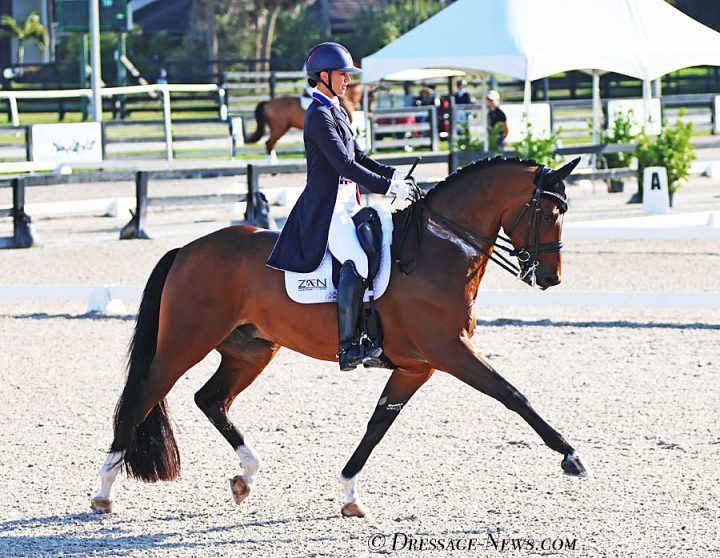
But Adrienne, 40 years old, the mother of a young child and three Olympics to her credit and based in Wellington, Florida in this week’s national championships is competing only a developing small tour horse, the nine-year-old Danish Warmblood gelding Hussmanns Topgun.
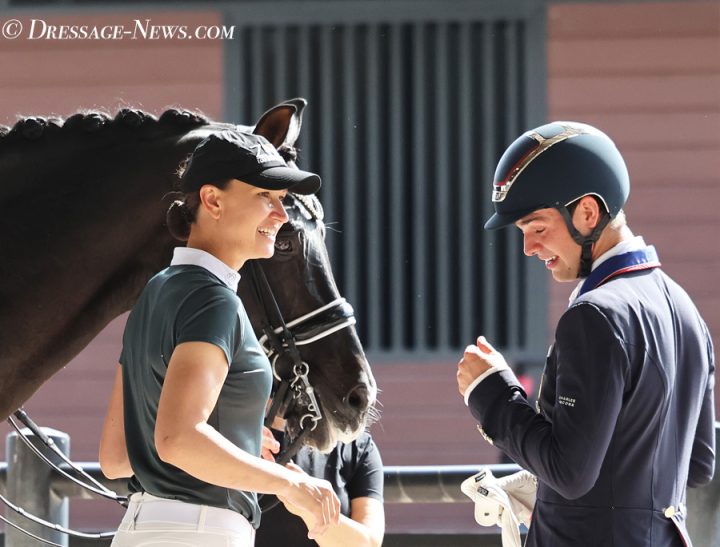
Instead, she’ll be wearing her coach’s hat, helping two Grand Prix combinations in the Dutta Corp. headline event, one in the Brentina Cup Under-25 division, one in developing Grand Prix and one in the seven-year-old horse class.
Podcast version:
Those she’ll be coaching are: Christian Simonson/Indian Rock and Katie Duerrhammer/Vividus QRE in Grand Prix; Christian Simonson/Fleau de Baian Under-25; Quinn Iverson/Gremlin 41 developing Grand Prix and Katie Duerrhammer/Rosebank VH 7-year-old horse.
Adrienne and Katie were team mates on the USA 2022 World Championship team and has coached both Katie and Christian at major European competitions as well as in the United States.
“I feel so fortunate that the teaching has been able to evolve inside my career, and now I’ve enjoyed teaching everyone,” Adrienne told DRESSAGE-NEWS.com. “I’ve enjoyed teaching amateurs, children, everything, but at the moment I’m really enjoying having all the riders that are focused on this as their career, this is their passion, this is their focus in life, and I really relate with that and so it’s just a really fun energy to be around like-minded people who are so driven and such dedicated students of this sport.”
Does Adrienne prefer riding or teaching?
“I love both. If I couldn’t ride, I would be very sad and cranky. So for sure, riding. The couple months I didn’t ride when I was pregnant, I was just miserable to be around. I felt sorry for everyone.
“So I learned I have to ride every day. But that being said, I don’t need to be in the saddle 12 hours a day. You know, that’s also not great for your body for longevity. So, I’m very happy with the mix now. Riding two-thirds of the day and then getting to teach great students on great horses for the other third. I think I would need both in my life to really feel fulfilled because I love the teaching part as well and I love being able to bring people along on a journey with you–everything that goes into it. the highs and the lows you’ve been there and done it now you’re going to experience someone else going through that whole process and that’s really special.
“Anyone who’s done high level competitions and Olympic Games and World Championships, you know from the outside it might always look like a smooth walk in the park with pretty Instagram stories and then down the centerline you go. And in reality it’s very seldom if ever a smooth ride. There’s ups and downs, there’s challenges you didn’t think were going to happen.
“Once you’ve kind of gone through that yourself, ‘oh I’m hoping I can be a bit hand holding supportive, I’ve been there don’t worry it’s going to be okay’ guiding people through and there, don’t worry, it’s going to be okay. And I think that means a lot because there’s so much more that goes into it than just being able to ride a good test. It’s all the outside management and controlling all those other variables.
“I think it makes you, it makes me at least, a better rider when I have to sit and break something down for a student and explain something. So many times I will give a lesson and I’ll get on my next horse and say that’s exactly what I needed to be doing on this horse yesterday why didn’t I think of that. But then I sat and explained it to a student when you’re watching it it seems so obvious and so I do believe that teaching makes you a much better rider. I’ve encouraged my students to get out there and teach anybody. I said it’s going to make you understand things so much better and so I think it’s helpful. It’s a different hat to wear and I’m very conscious of not trying especially now not to overextend.
“And now we have a daughter as well And I’ve got a bunch of lovely horses to compete and so you have to be very careful with your time management. I wish I could teach everyone in the world that wanted lessons, because I love teaching and I love sharing my knowledge, but you have to be realistic and pare it down to where you’re never compromising the time that you spend on your horses that you’re riding in your own training and competition goals. I’ve got it down to a smaller core group of students and they’re very self-sufficient as well.”
Adrienne first learned to teach in the U.S. Pony Club when growing up in Washington state. The program aimed at helping older members “not what to teach necessarily, but how to teach. That is where I started at a pretty young age and figured that I enjoyed that a lot. I enjoyed trying to figure out how to explain things and make sense to the riders obviously at a very low level and then backyard kind of stuff, Then as my career advanced and I kind of went into the high performance stuff, the teaching evolved with it, and the clients and the students that I had evolved more toward those with high performance international goals like myself.”

She started with Debbie McDonald as a working student two decades ago. Although Debbie is relatively tiny and Adrienne is much taller, she passed along the principles of classical dressage learned from German Olympic gold medalist and former American team coach Klaus Balkenhol. Debbie now spends much of her time with her family in Idaho.
The U.S. is rebuilding after the retirement of horses that were on silver medal-winning teams, but Adrienne thinks there is a lot more cohesive step-by-step guidance for riders.
“It felt much more individualistic when I was first going over to Europe.,” she said. “Thankfully I had Debbie who had done it all and knew it all but it felt more like you were kind of out there on your own and now we have these developing horse programs, emerging athletes programs that I feel like it’s a much clearer way for people to get plugged into the sport and to figure out how they should be advancing through these levels.”
Salvino that she rode on both the Olympic and WEG silver medal teams was developed by Adrienne. from a top sport prospect to Big Tour and was fit enough to compete until the age of 17.
“I think that that’s really what it’s all about–learning how to develop a horse and bring a horse along.” she said.
“That’s something that I try to keep at the forefront for myself, but also for my students as well.
“This is not a show up, your horse is tacked up, you ride for 45 minutes and go home kind of program. Anyone that rides with me, it’s about all the management. The vet care, the daily management of the horse, the training, the long-term philosophy, all the parts that make a difference. It’s so much more than just the lesson time and the time in the saddle. That’s a small percentage of what makes or breaks it, and honestly, most of it happens outside of the saddle.
“Planning, their physical health, their mental health, planning their their training program, a competition, a strategy, as well as treating yourself as an athlete. You know, how do you physically stay so that you’re the best rider you can be? How do you stay symmetrical so that you train up a young horse that is symmetrical, you know, because our flaws transfer over to them. And it’s really looking at the holistic picture of all the little parts that go into it and not just thinking that it’s what happens when you hop on your horse and ride for 45 minutes. That’s an important part of it, but that will never be enough.”
